top of page


Launch Deck
PROJECT

DURATION
2023-present
ROLE
UX Designer
TOOL
Figma
TEAM
3 Product Managers
2 UX Designers
Overview
About Launch Deck
Launch Deck is a strategic platform built to bridge the gap between visionary founders and sophisticated investors. In an ecosystem where fundraising can often feel fragmented and opaque, Launch Deck streamlines the process by facilitating meaningful connections and investment opportunities.
My role
My role was to transform the complex, high-stakes journey of venture capital into a seamless digital experience. I focused on designing an interface that balances the professional rigor required by investors with the high-energy, storytelling needs of founders launching their next big idea
Goal
Our main goal with building Launch Deck was to reduce friction in the fundraising cycle. By prioritizing information architecture and trust-based design patterns, I aimed to foster stronger relationships between users and increase the speed of investment facilitation.
Research
Insights
Early research and competitive analysis surfaced four questions that shaped the platform's direction:
Why would you choose Launch Deck over competitors?
Competitive audits showed users are overwhelmed by "generalist" noise. Founders favor a high-signal environment where every interaction is curated for funding, not a browsing experience like a standard job board.
What would add real value for investors?
Investors need more than a basic marketplace, a transparent portfolio dashboard with real-time growth data, replacing the "black box" feeling typically associated with early-stage investing.
What would add real value for founders?
Founders are buried by investor noise and the administrative burden of unqualified leads. They need a conversion funnel, not an open directory, the ability to lock down documents and see real-time engagement from specific stakeholders.
Where do deals typically break down on other platforms?
Both sides consistently cite the same failure point: communication gaps in high-volume marketplaces. A single source of truth for all communication, replacing fragmented emails and static PDFs solves for both.
Analysis
Traditional platforms function as noisy, transactional directories — founders compete for attention in a crowded marketplace, and investors sift through scattered emails and static PDFs to track deals. Launch Deck replaces that with a single, high-signal workspace: real-time portfolio visibility for investors, and a secure, organized pipeline for founders to manage every stakeholder relationship in one place.
That shift comes with real structural advantages. Launch Deck costs nothing to start, so founders keep every dollar raised instead of losing 6–10% to platform fees. Operating under Reg D means no cap on maximum raise size and none of the compliance delays common on other platforms, while flexible minimum raise requirements adapt to a company's stage. The result is a unified workspace — investor communications, data rooms, and pipeline tracking — that replaces fragmented tools with one professional system.
Competitive Analysis

Target Audience
The target audience spans distinct user segments with specialized needs: early-stage founders who need a professional 'front door' for pitches to counter information asymmetry; B2B sales and marketing teams navigating complex deals to eliminate process friction and track high-intent leads; and customer success managers requiring a centralized source of truth to streamline post-sale handoffs.
Focus Area | Early Stage / Founders | B2B Sales & Marketing | Customer Success Managers |
|---|---|---|---|
Primary Goal | Professionalize fundraising & protect data | Navigate complex, multi-stakeholder deals | Manage seamless post-sale handoffs |
Core Pain Point | Information asymmetry & lack of visibility | Process friction & long sales cycles | Loss of continuity during onboarding |
Key Platform Need | A professional "front door" for pitches | Real-time tracking of high-intent leads | A centralized, consistent "source of truth" |
Exploration
Solution Synthesizing
Solving for "generalist noise" and "information asymmetry" meant building around three pillars: Curated Transparency, Administrative Automation, and Real-Time Intelligence.
Goals
Turn fundraising from a fragmented, manual effort into a streamlined, data-driven workflow for both sides of the deal.
Stakeholder Needs
Founders needed control over who could see their data and when. Investors needed consistent, comparable information instead of every founder presenting differently.
Interface Creation
I designed a central workspace that consolidates scattered communication into a single thread per deal, and a clean, professional dashboard built to establish trust at a glance, critical in a process where first impressions affect funding outcomes.
User Journey Mapping
Mapping out the user journey was a core focus of this project, allowing me to map every step a person takes inside the application from start to finish. This exercise helped spot friction points early and made it much easier to refine the overall flow, ensuring a smooth and intuitive experience for everyone using the product.

Wires
Wireframing
The initial wireframing phase prioritized establishing the structural foundation and core functionality of the Launch Deck ecosystem. By leveraging a low-fidelity approach in Figma, I facilitated rapid iteration across complex multi-user layouts and interaction paths. Key activities included:
End-to-End Journey Optimization
I audited the platform’s end-to-end journey, focusing on the high-stakes transition from initial founder setup to investor due diligence. By mapping out secure credentialing, document permissioning, and engagement tracking, I optimized the pathways for capital exchange and administrative oversight to ensure a seamless "path to close."
Eliminating Mental Friction in Due Diligence
To architect a high signal interface, I used wireframes, placing the focused financial elements and due diligence clicks in positions where they could most effectively influence the investors. To provide a priority structure for “closing” data, the design focused on guiding investors through the complex deal rooms without any mental friction, keeping every screen of the process fixed on capital commitment.
Iterative Prototyping for Data-Driven Clarity
I worked on prototyping various layout options to create a data-driven hierarchy to ensure key “closing” indicators stood out at all times. I achieved this by creating a navigable system through various spatial arrangements, which organized complex due diligence documents to create a functional workspace.
Founder
To fill the existing chasm between vision and investment, I have developed a high-conversion portal that focuses heavily on easy deployability. The portal aims to maximize ease of deployment and empower entrepreneurs to quickly assemble their digital data room and manage investor or stakeholder accessibility, thus making this tedious process a differentiator.

Investor
The investor portal needed to be a high-fidelity assessment toolkit that aimed at simplifying due diligence work. With this system, information sprawl was addressed, as sensitive assets are now streamlined and information hierarchy made consistent, hence encouraging investors to swiftly transition from discovery analysis to detailed analysis.
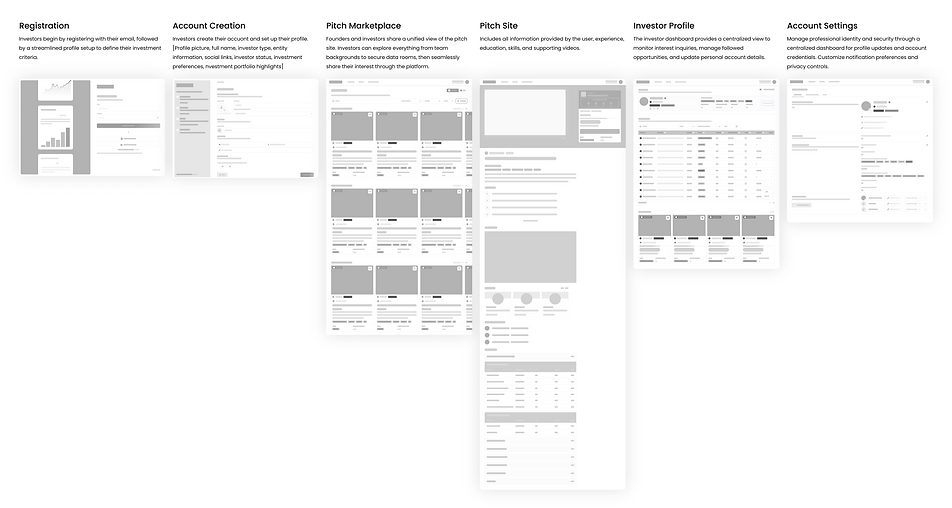
Founder Portal
Sign Up


Dashboard

Investor Details

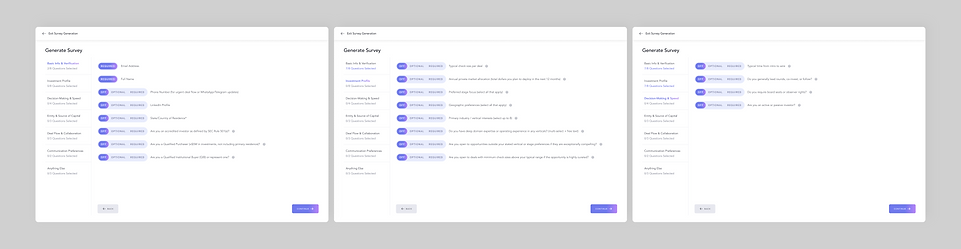
Survey Generation
Settings

Investor Portal
Sign Up
Dashboard

Settings

Website
Launch Deck's public site introduces the platform to both founders and investors before they ever sign in, establishing trust and setting expectations for the workspace they're about to enter.

bottom of page